
They lie, cheat, manipulate and betray. They make one questionable decision after another, cross moral lines and sometimes even commit a crime or two. They are the embodiment of the term “red flag,” with barely a redeeming quality in sight–yet somehow, they still manage to captivate fans.

There is a strange loyalty that comes with having a favorite anti-hero. The kind that makes fans overlook their worst decisions, defend their most questionable actions, and, at times, argue that they aren’t as bad as everyone else views them to be.
Yes, they are flawed, but after spending hours watching their stories unfold, it becomes difficult to simply write them off as villains.
“A girl will choose her favorite anti-hero and stick with it”

But what exactly makes someone anti-hero?
Merriam-Webster defines the term as “a protagonist or notable figure who is conspicuously lacking in heroic qualities.”
Unlike the traditional heroes, an anti-hero does not always have a moral compass, selflessness or nobility that are usually associated with protagonists such as Superman or Spider-Man. They can be selfish, violent, manipulative, or driven by their personal motives that are far from heroic.
Author Stephanie Brown similarly defined an anti-hero as “a main character that we root for despite their obvious flaws, bad behavior, or seeming immorality.” Their actions, she added, drive the narrative as they pursue a goal that doesn’t necessarily have to be noble.
Ellie from the video game ‘The Last of Us Part II’ is a prime example. After Abby Anderson kills Joel in retaliation for her father’s death, Ellie sets out on a path of revenge that gradually blurs the line between protagonist and antagonist.
Driven by grief and anger, she leaves a trail of violence in her pursuit of Abby, pushing her further from the character players once knew. Yet her pain, past, and vulnerability make it difficult to simply turn against her.
V from ‘V for Vendetta’ is another compelling example. His methods are difficult to defend, but his cause helps audiences understand and even support him.
Behind the mask, V uses violence, deception, and destruction to fight an oppressive government. His actions may be morally questionable, but his fight for justice and freedom gives viewers a reason to root for him anyway.
They’re not exactly heroes, but they aren’t always written as straightforward villains either. Instead, they exist somewhere in the messy middle—where audiences seem to love meeting them.
And maybe that messy middle is exactly where the thrill begins. There’s something inherently compelling about characters whose actions we condemn, yet whose fate we still care about.
As it turns out, our fascination with morally questionable characters isn’t entirely irrational. Research on anti-heroes found that audience identification plays a role in how much viewers like morally questionable characters.
“One explanation for identification’s role in the enjoyment of antiheroes may be that viewers perceive such characters as more realistic than their near-perfect traditional hero counterparts,” researchers Sophia Janicke and Arthur Raney stated.
Unlike traditional heroes who often embody clear-cut ideals of courage and morality, anti-heroes are defined by their flaws, contradictions, and imperfect choices.
And fans themselves seem to understand the appeal. In a Reddit discussion on anti-heroes, commenters pointed to the appeal of characters who are far from the traditional “good guy.”
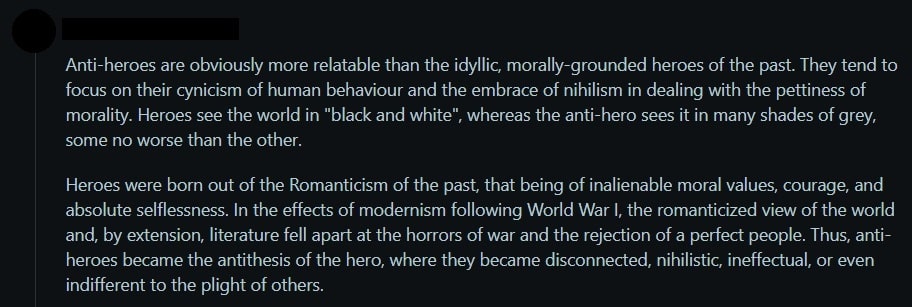
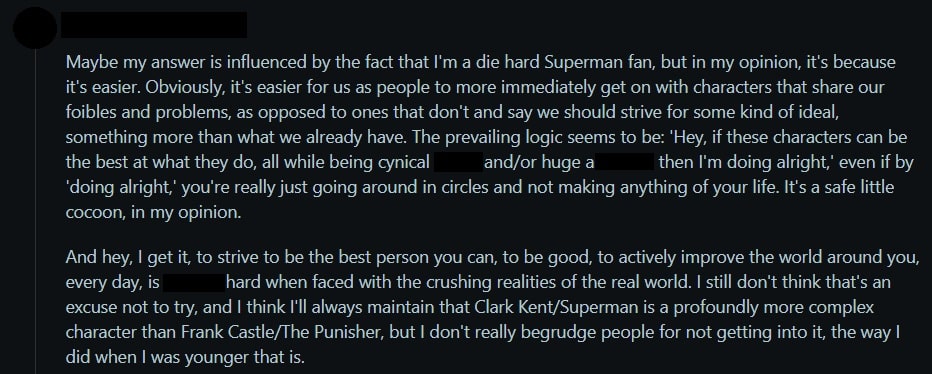
One Redditor said that it’s easier to connect with characters who “share our foibles and problems” than with heroes who represent an almost impossible ideal. Another commenter put it more simply: anti-heroes “start from desires and needs that we understand.”
Fiction gives audiences something real life rarely does: a front-row seat to someone’s thoughts.
We see their past, insecurities, relationships and motivations. We witness what happened before they made the wrong decision, and sometimes, we even understand why they thought it was the right one.
That context can make a character easier to sympathize with. It doesn’t necessarily make their actions right. It simply makes them human—and perhaps makes it easier to see ourselves in them.
When we think about it, we may not relate to committing a crime or betraying someone, but we can understand wanting to be loved, feeling rejected, being angry at the world, or making a decision out of fear. Anti-heroes take those very human emotions and push them to extremes.
“Mama, I’m in love with a criminal”

Sometimes, it’s not just the character but how the story tells us to see them. The more time we spend with their fears and struggles, the harder it becomes to simply label them as “the bad guy.”
We may not agree with their choices, but understanding where they come from can make us hesitate before completely giving up on them.
Once known as the Winter Soldier, Bucky Barnes spent years being used as a weapon and forced to commit violent acts against his will. While the damage he caused can’t simply be undone, seeing his struggle to reclaim his identity and make peace with his past gives audiences someone to sympathize with.
Even ‘Loki’ head writer Michael Waldron believes that Bucky is the best character from the Marvel Cinematic Universe to receive the same treatment as the God of Mischief.
“I love Bucky. I think Bucky is a great character. Like Loki, that’s somebody who has a lot of trauma that they’re working through, but there’s a real vulnerability and likeability there. So, I like Bucky a lot,” Waldron said.
And perhaps that is what makes Bucky’s appeal lie. Characters like Bucky are the kind of characters audiences want to see win. Audiences don’t root for him because his past has been disregarded, nor are his actions simply erased, but because they’ve witnessed his struggle to move beyond it.
There is something deeply satisfying about watching him, who was once defined by what was done to him, reclaim the agency to decide who he wants to become.
Loki, on the other hand, follows a different path. He was a selfish, manipulative god who was constantly caught between wanting power and wanting to belong. Yet as audiences got to see more of his loneliness, insecurities and complicated relationship with his family and himself, the villain becomes someone much easier to understand.
His redemption feels rewarding precisely because we’ve seen how difficult it is for him to get there. It has been shown to us time and time again how awful and deceitful he could be, but what kept us watching was the possibility that he could choose differently.
And when a character finally breaks from the patterns after a history of poor choices, it becomes difficult not to hope or root for their redemption. The ending of ‘Loki’ Season 2 proved this, as Loki ultimately sacrificed himself to hold the timelines together, choosing others’ freedom over his own.
But not every morally gray character follows the same path.
Walter White from ‘Breaking Bad’ is perhaps one of the clearest examples of how storytelling can keep audiences engaged with a character even as his actions become increasingly difficult to defend.
The story begins with a struggling teacher who wants to provide for his family and watch as that motivation slowly gives way to pride, power, and violence.
At first, we understand Walter. But eventually, we have to confront the possibility that understanding him does not mean we should continue rooting for him.
While there is an exciting rush in rooting for an anti-hero, it also comes with moral discomfort. There comes a point when sympathy begins to resemble complicity–we recognize that Walter has begun crossing lines, yet because we’ve seen his beginning, a part of us remain invested in seeing how far his choices would take him.
Rafe Cameron from ‘Outer Banks’ is another similarly complicated character–violent, unpredictable, and responsible for some truly destructive decisions. There is a divide among fans of the Netflix series as to whether he deserved a good ending, but many continue to point to his familial struggles and desperate need for approval as reasons to believe he is capable of redemption.
Rafe is especially interesting because he makes the very question of character redemption harder to answer. It’s easy to sympathize with characters whose mistakes carry little consequences, but that same sympathy becomes far more difficult when their actions have caused genuine harm to others.
Jonas Pate, creator of ‘Outer Banks,’ ultimately decided to give Rafe’s character another chance at life and atonement. By the series finale, Rafe turned away from his destructive past and reconciled with his sister Sarah before beginning a new life with his girlfriend Sofia, suggesting that redemption remains possible even after a significant amount of harmful choices.
And perhaps that is what makes characters like these so compelling.
Why we root for the morally gray

Understanding a character is not the same as excusing them.
We can think a character is terrible and still find their story fascinating. We can condemn their actions while hoping they succeed. We can even love watching a character without wanting anything about them in our actual lives.
Anti-heroes–and the morally gray characters who exist alongside them–let us explore the uncomfortable gray areas of morality without having to live with the consequences ourselves.
They challenge our ideas of who deserves sympathy and redemption, and whether being a good person is really as simple as doing the right thing.
Maybe we don’t root for anti-heroes because we think they are like us. Maybe we root for them because, somewhere between the red flags and bad decisions, they give us a story complicated enough to care about.
Other POP! stories that you might like:
The baddest b****** ain’t in L.A., neither is success
Vaseline ‘rebrands’ as ‘Baseline’ after Korean creator’s pronunciation goes viral
Amelia Dimoldenberg bids goodbye to hit series ‘Chicken Shop Date’
