
There was a time when watching a television show was like entering and committing to a long-term relationship.
22 episodes could take you from July to January of next year. There used to be holiday specials, ridiculous side plots, episodes that took forever to move the story forward, and cliffhangers that had viewers at the very edge of their seats.

Today, eight episodes is already a full season. The show is already over just as soon as we get attached. Series have become shorter, tighter, and in many ways, more intentional—the new normal for television.
Television was meant to tell stories over many hours, sometimes even years. So why has it been shaped to feel more like a movie?
Remember when TV shows had more than eight episodes?
For many years, American television shows ran a familiar rhythm: seasons with 20 to 24 episodes. These shows were built around a weekly schedule that could stretch for months, giving viewers a chance to test their loyalty by anticipating new episodes each week.
Think ‘Friends,’ ‘Grey’s Anatomy,’ ‘Vampire Diaries,’ ‘Gilmore Girls,’ ‘The Big Bang Theory,’ or ‘Supernatural.’ These popular series ran for years and years which overtime equated to more than a hundred episodes.
There was a certain comfort in knowing there would always be another episode next week. A guarantee that audiences would be spending much of their time with their favorite characters.
However, television seemed to have felt the need to be efficient.
As ScreenRant’s Tiffany Beverly explained, streaming helped make shorter TV seasons the norm. When Netflix entered “original programming” in 2013 with ‘House of Cards’ and ‘Orange is the New Black,’ both debuted at 13 episodes, cable networks such as HBO and AMC had already adapted the format long before.
“Since streaming platforms don’t have to take breaks during summer and winter like broadcast networks did, they can drop entire seasons of a show at once instead of spreading out a season’s episodes over several months,” she said, adding that streaming platforms made the 8-episode practice mainstream over time.
Television production isn’t the only thing that streaming platforms have reshaped. In a Medium post, blog writer Keith Price argued that streaming has changed not only how audiences watch TV, but also how willing they are to begin a new series.
With Netflix, Hulu, and Prime Video making full seasons readily available, binge-watching has become the dominant way many viewers experience TV.
As Price wrote, “It’s easier for people to commit to a series because they know where the endpoint is.” Rather than waiting a whole week for the next episode, viewers can now move through a story at their own pace–often from its first episode to its finale in a single weekend.
“Modern life has become very fast-paced, and we’re surrounded by various forms of stimulus at nearly all times. Consequently, fixing our attention on things for dedicated periods of time has almost become something of a challenge now,” he continued.
If given much thought, it makes sense that even watching television has become more efficient. It’s easy to understand why television had to change its rhythm. Why spend months following one show when you can finish it over a weekend? In a world of endless streaming libraries, a shorter season feels like a promise that it wouldn’t take too much of your time.
But is it really what audiences want? Or what television companies have decided is best for them?
We don’t watch TV the same way anymore
Some viewers are calling for the return of the 20-plus-episode seasons. It isn’t necessarily a demand for television to go back in the past, but a longing for the opportunities longer seasons once gave audiences—more time to understand characters, linger in their worlds, and let a story unfold.
Bennett Miller from Substack perhaps explained it best. “Being able to watch a whole season in a day, of course, is super convenient, but I believe that this doesn’t benefit every show. Some series need to take time to build up suspense and give you a reason to care about our central characters,” he wrote in a post.
He continued that “a lot of fat is eliminated from television.” Filler episodes, side characters, cliffhangers, are some of the TV ingredients that are less common nowadays. Blog writer Keith Price shared the same sentiment, saying that as these elements appear less often nowadays, the art of “worldbuilding” has suffered.
“Sure, having 8 episodes in a series allows for a more streamlined experience. However, if a season’s entire narrative is condensed into just a few hours of content, then when do you get an opportunity to immerse yourself in the fillers?,” he wrote.
Price also acknowledged the other side of the coin—studios and companies being hesitant to invest in projects whose success is uncertain—and further explained that it’s easier to produce limited content than to commit to traditional full-length seasons.
He, however, pointed out that it can also lead to “situations where new shows are produced more often with hit-or-miss levels of quality” just to see what works with fans.
“On one hand, an 8-episode series could be a top-viewed moneymaker. On the other hand, it could have a significant drop-off in viewership, in which case, losses can be cut without having wasted too much capital,” Price said.
For streaming platforms, the goal is to introduce new titles that can convince people to subscribe. As actor Sterling K. Brown put it, streaming platforms are looking for something “new and shiny” that makes viewers think, “Oooo, I wanna see that.”
The award-winning actor explained that networks profit from more episodes through advertising, while streaming platforms rely primarily on subscriptions.
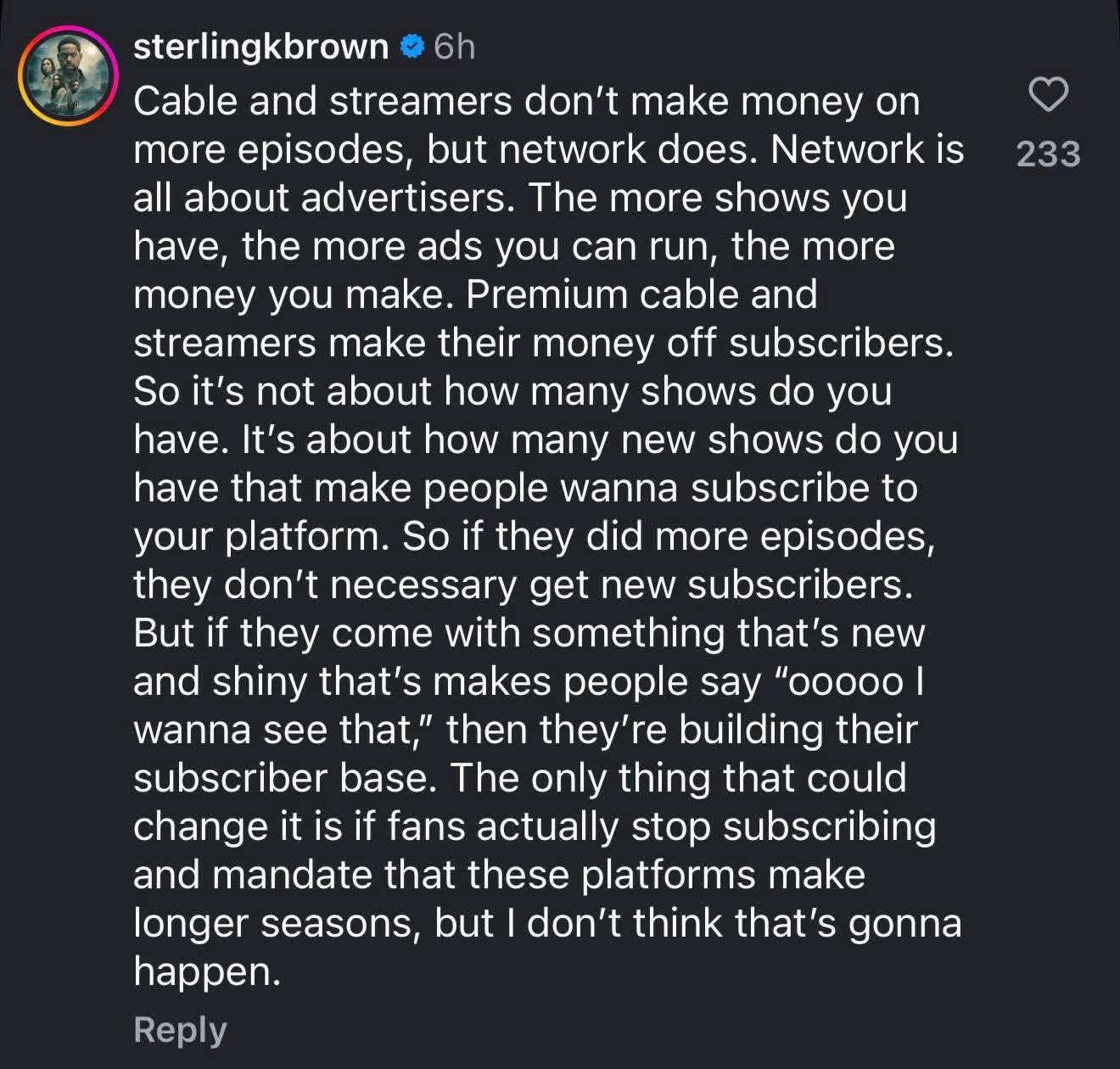
“[So,] it’s not about how many shows [you have.] It’s about how many shows [you] have that make people wanna subscribe to your platform,” Brown said.
And unless audiences collectively stop subscribing and actually demand longer seasons, the award-winning actor believes that there’s little financial incentive for streaming platforms to change that model.
Shorter doesn’t necessarily mean worse—or better
There’s no denying that shorter seasons have their advantages. It can give stories room to breathe. Writers can focus on the heart of the narrative, cut the unnecessary detours, and build a season around a story that knows exactly where it wants to go.
In the same ScreenRant article, Tiffany Beverly appealed the benefits of shorter TV seasons: fewer risks for networks, straightforward plots, and better production values and budget.
Beverly explained that with eight-episode runs, networks are able to improve production values that tell “a better story without needing to add filler” and “better respond to fan demands.”
“Many shorter seasons are able to provide quality content. There are still entertaining programs with 20+ episodes, such as the 22-episode Abbott Elementary season 2, but a lot of the best shows on TV have shorter seasons,” she said.
However, the shorter television format comes with a catch. Fewer episodes may mean less story to tell, but it doesn’t necessarily mean less time spent making it. If anything, an eight-episode season can take longer to reach the screen.
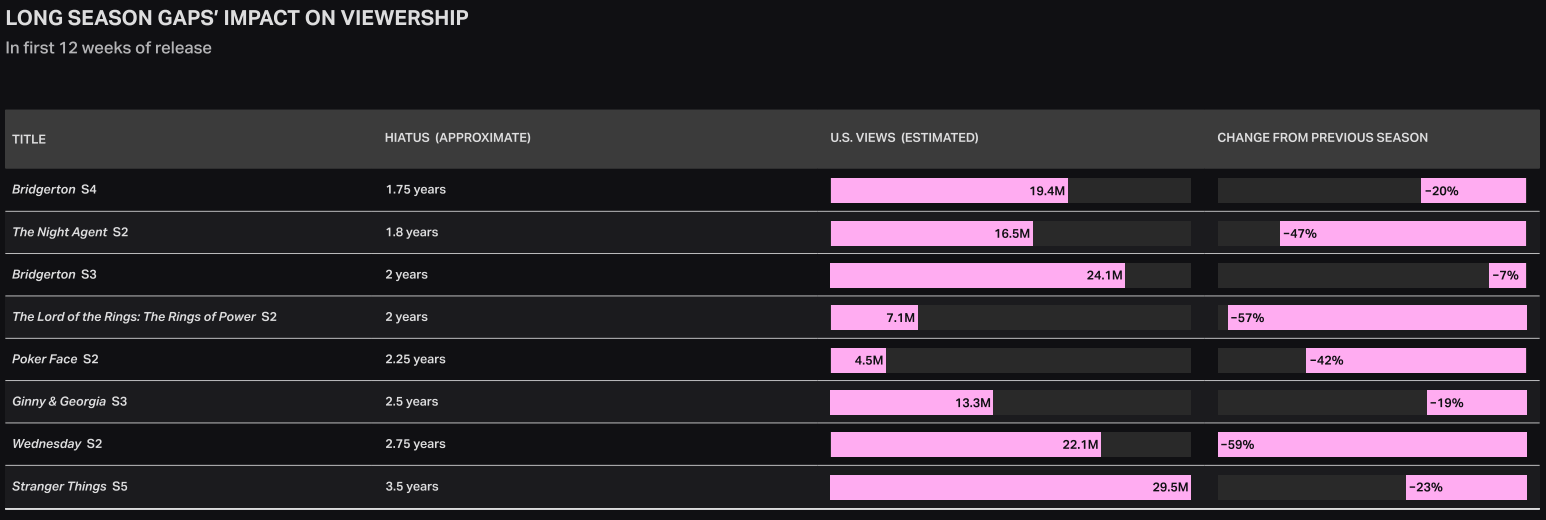
In a recent report, Luminate Intelligence pointed out that “lengthy gaps between seasons have been a persistent headache for streamers.”
“Average views dropped for every title in a sampling of recent hits—even ‘Stranger Things’,’ [viewership went] down nearly 25% in its final season,” Luminate reported, adding that viewers want hit shows to return faster, but that can be difficult, especially when they require “extensive post-production work.”
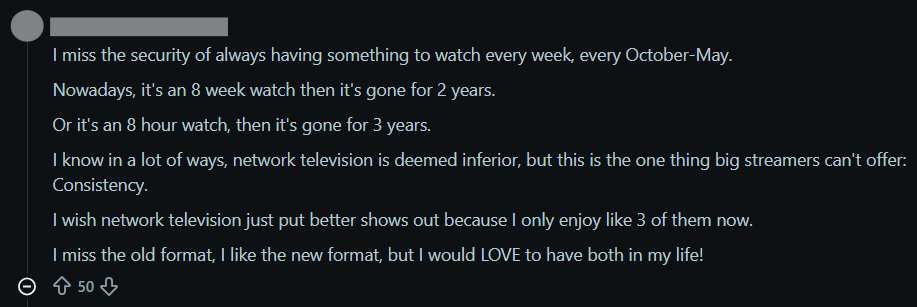
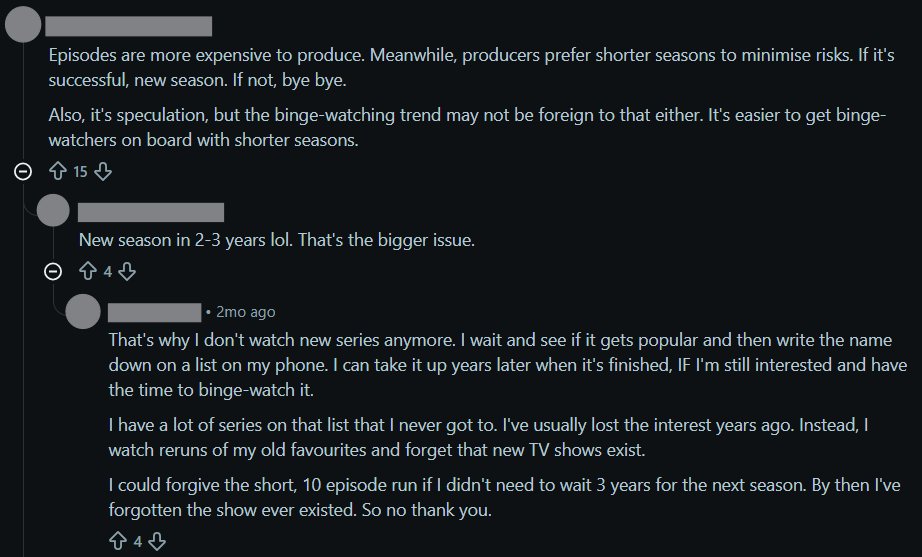
Reddit users echoed their frustration over the long gaps between seasons. While some appreciate the convenience of shorter seasons, others seem to miss the consistency and familiarity that came with traditional television schedules.
Don’t dream it’s over
“When I watch one of my favorite shows, I get lost. I travel to a world that is not my own. I get to escape what is happening in my life and ‘live’ in someone else’s,” Medium writer Jessica Levine wrote.
When a show becomes a place for someone to escape to, eight episodes can sometimes feel like too little time before the light comes back on. And instead of following a weekly routine, viewers would have to wait years before they could return to their world.
Perhaps that’s why the changing of the television landscape can feel a little bittersweet. Shows are no longer something viewers immerse themselves in every week. They’re merely something one consumes, finishes, and moves on from.
But the appeal of television has never been only about how many episodes it has. It’s about having a full story to return to, characters to grow attached to, and a world that can feel familiar enough to return to.
Television may continue to change, but the reason people fall in love with it remains the same.
Other POP! stories that you might like:
Why friendship breakups hit different
All the iconic moments straight from the Victoria’s Secret 2026 runway
Dearest gentle reader, here are the 9 Bridgerton tropes we know and love

