
“Pick me. Choose me. Love me,” is what Meredith Grey said to Derek Shepherd when she begged him to choose her over his wife in ‘Grey’s Anatomy.’
It was an emotional declaration in a messy love triangle, but the phrase eventually escaped the hospital halls of Grey Sloan and became a meme in pop culture spaces.

Years later, “pick me” carries a very different meaning online. No longer just an earnest plea to be chosen, it has become shorthand for a certain kind of woman: one perceived to seek male validation, often by distancing herself from or putting down other women.
The term begs a question that is worth asking: When did calling out women’s need for validation become another way of pitting women against each other?
The Internet’s favorite accusation against women
There’s a difference between Meredith’s original plea and how the term is used commonly today. Meredith wasn’t trying to establish herself as better than Derek’s wife, Addison, or generally other women. She was asking Derek, the man she loved, to choose her unconditionally.
The Internet, however, eventually stripped the phrase of its original context and gave it another meaning that has twisted society’s perception of women even more.
Iman Hariri-Kia from Cosmopolitan described it best.
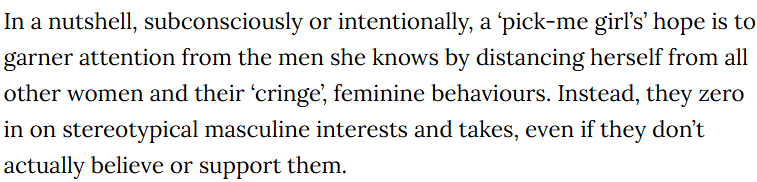
In a Medium post, blog writer Zarah explained that such girls value male attention over forming genuine connections with other women,” which stems from “a desire for acceptance and approval, and (ends) up in a cycle of seeking validation from others rather than valuing themselves independently.”
“As women, we are conditioned to be pitted against one another, tear each other down, judge one another, and blame each other for the actions of men,” she explained.
This is certainly behavior worth criticizing. Uttering the phrase “I’m not like other girls” while mocking other women isn’t harmless just because it happens behind a screen.
‘Obsession’ actress Inde Navarette recently became the target of the “pick me” personality after a clip from her ‘Hot Ones Versus’ episode went viral for her simply placing a spoonful of peanut butter on her tongue.
The moment prompted criticism online, with some viewers labeling her behavior as attention-seeking.
Impact Media later weighed in on the backlash, offering their own commentary on the matter. They noted that the insults hurled at Navarrette “largely stem from (her) traditional male interests”—watching anime, streaming on Twitch, drinking beer, and playing video games.
But none of those interests inherently come at another woman’s expense. It raises another important point: If a woman likes things stereotypically associated with men, she risks being accused of “performing” for male attention.
So, what exactly is allowed for girls to like before their interests stop being treated as evidence against them?
“Unfortunately for girls everywhere, the pick-me girl is still alive and well. She marches on, paving the way for the “cool girl” and ‘not-like-other-girls girl,’ holding the baton for setting female rights back,” Substack writer Livia said.
Apparently, there’s a right way to be a woman

The debate around “pick me” points to a larger contradiction in how women are expected to behave or present themselves.
Women are told not to care about male validation, yet they’re still judged by standards of attractiveness, desirability, and likability. Even rejecting those expectations can invite another kind of judgment.
America Ferrera’s much-discussed dialogue in ‘Barbie’ (2023) revolves around precisely that contradiction: be exceptional, but not too much; be confident, but not arrogant; be yourself, but only if “yourself” fits within the narrow lanes society has carved out for women.
“It is literally impossible to be a woman. You are so beautiful, and so smart, and it kills me that you don’t think you’re good enough. Like, we have to always be extraordinary, but somehow we’re always doing it wrong.”
In her Substack post, blog writer Kate Hearsay explained that seeking external validation from anyone isn’t sustainable, reasoning that females tend to prioritize it because “it’s faster and more tangible.”
“To stop being a pick-me, you have distill it down to its most basic parts. If a pick-me thrives on the validation of men at the expense of women, then there are two hurdles in front of you: learning to appreciate femininity, and getting your validation from something else. Luckily, I think the two go hand in hand,” Hearsay added.
The key phrase is “at the expense of women.” Wanting to feel seen, appreciated, or chosen is hardly unique to any woman, and it doesn’t automatically make someone a “pick me.”
These snide remarks further underscore the sad truth: The label is sometimes less about the women being criticized and more about competition among women.
One commenter described the discourse around Navarrette as “intersexual competition,” suggesting that jealousy may be behind the accusations. Another argued that the term is sometimes used as a “virtuous reason” to disguise personal dislike.
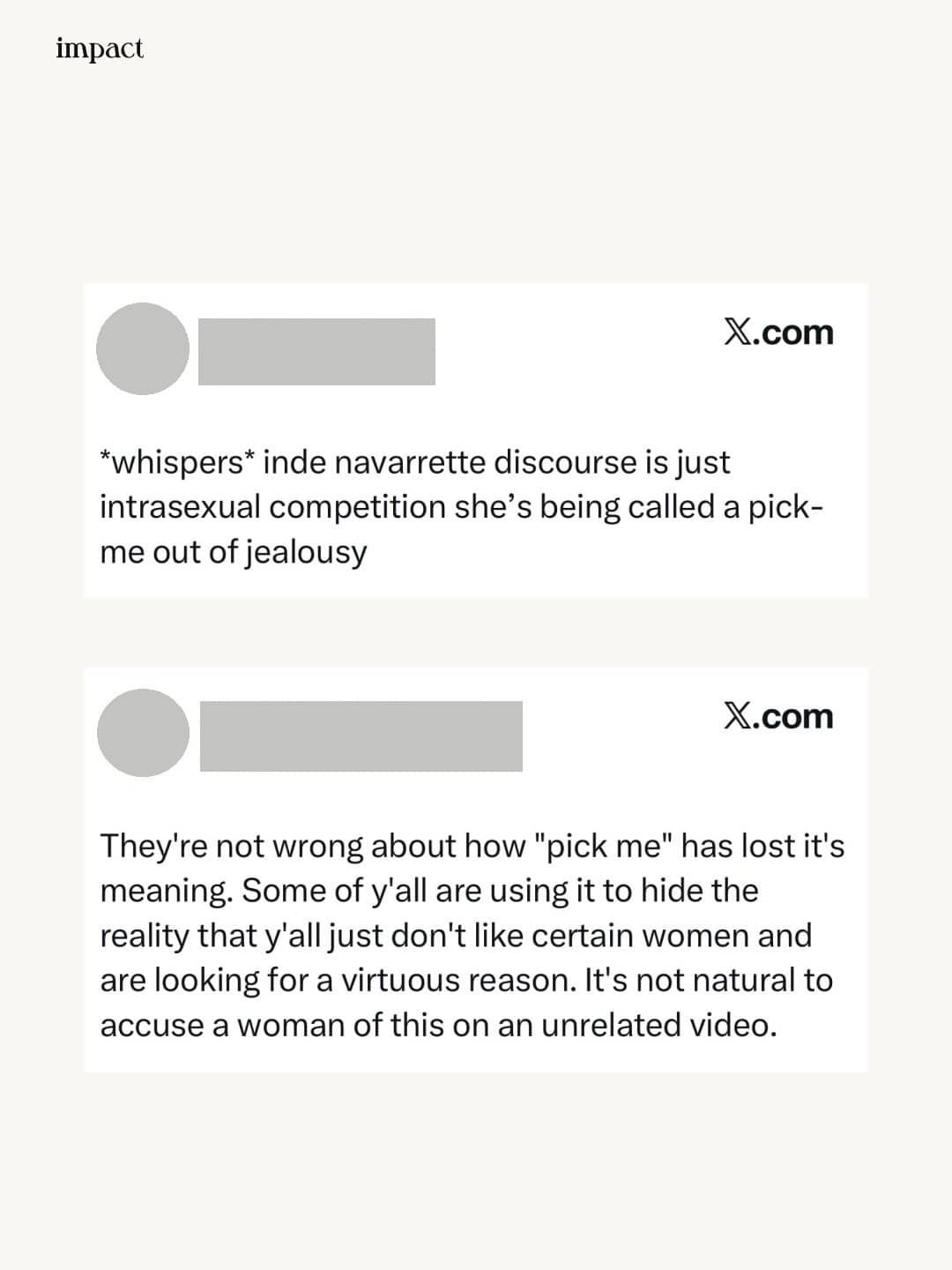
Together, the comments question whether every accusation of being a “pick-me girl” is really about behavior or whether the label has become an easy way to justify disliking certain women.
To be a girl’s girl
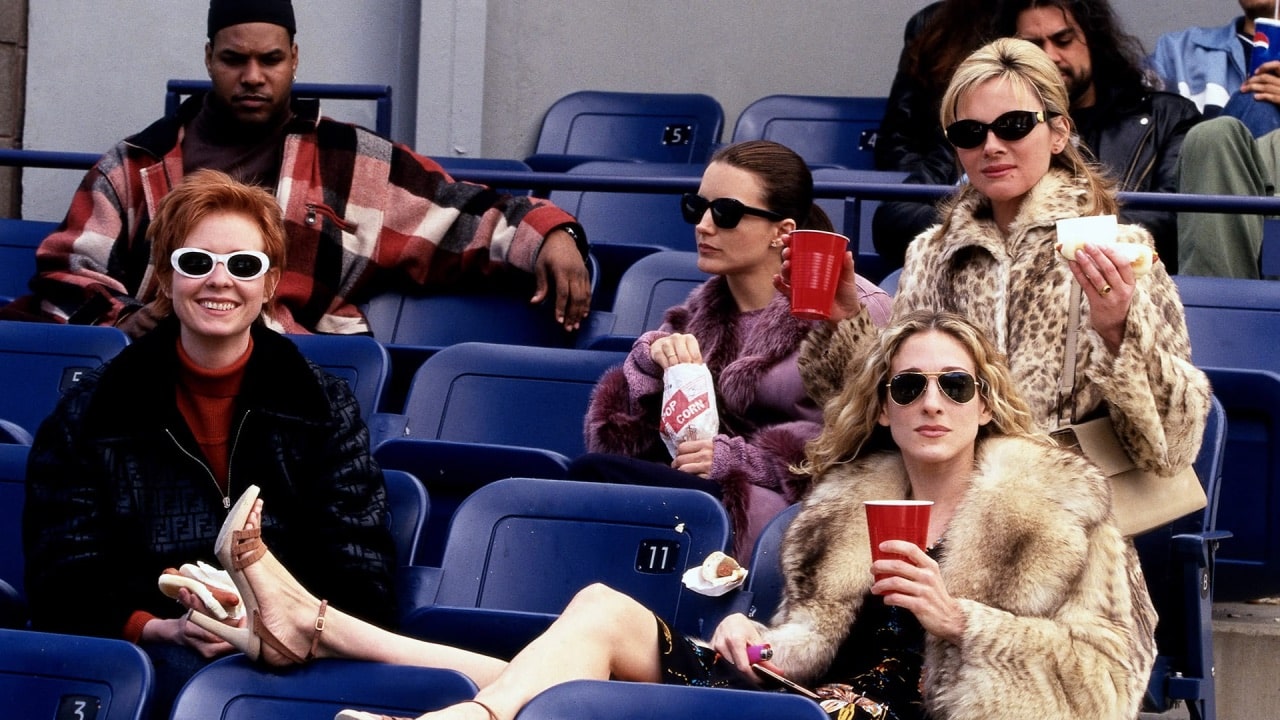
Hearsay also wrote that “a pick-me girl is a human like the rest of us, motivated by the ‘wrong’ things.”
Perhaps that’s what gets lost when ‘pick me’ is used as the easiest punchline against other women—behind the label is still a person who, like anyone else, can crave attention, struggle with insecurities, or want to feel accepted. Those motivations may not always lead to healthy behavior, but reducing someone to a two-word insult does little to explain why they behave that way in the first place.
Understanding the motivation, however, doesn’t mean that such harmful behavior should be ignored or unchallenged.
Women can–and should–call out women who deliberately tear others down for validation. The conversation should stay focused on the behavior.
Not every woman who’s different from the other is “performing.” Not every woman who wants to be liked is desperate for attention. And not every choice a woman makes needs to be interpreted through the question of whether a man–or the society–would approve of it.
Sometimes, she just likes what she likes.
Other POP! stories that you might like:
Where can we go when we just want to exist? Filipinos yearn for third places
‘Be kind,’ netizens rally behind artist of viral Alex Eala statue

